I'll venture to guess that virtually every birdwatcher has seen the comical video, first posted on YouTube back in 2006, of a male Red-capped Manakin performing its "moon walk" mating dance dubbed to Michael Jackson's "Billie Jean." Well, here's another featuring in this case an American Woodcock, a.k.a. timberdoodle. Unlike that of the manakin, the woodcock's fancy footwork has been suggested to be a feeding tactic used to agitate earthworm activity in the soil enabling the bird to locate its quarry. Earthworms are reported to comprise about 60% of its diet with the remaining balance being other assorted invertebrates. Feeding is done by the bird repeatedly penetrating moist, rich soil with its long (2.5-3.0") bill. The bill has a flexible tip that enables it to clasp a worm underground without the need to open the entire bill. Just what the woodcock featured in this Dance video is trying to accomplish, only it knows...perhaps rehearsing its routine for an upcoming "ice dancing" event. Anyway, while watching the clip I dare you not to be pleasantly entertained.
The video was recorded by Bill Hubick, who along with Jim Brighton have launched the Maryland Biodiversity Project, an endeavor with the goal of cataloging every living thing found in Maryland at a single website: marylandbiodiversity.com.

Wednesday, February 5, 2014

Sunday, November 24, 2013
Cats & Birds: A Longtime Conservation Struggle
The impact of free-ranging domestic and feral cats on bird populations has been researched and reported in the media for at least several decades. And, at least as old, are the heated debates between cat defenders and bird conservationists. One of the most current published studies of cat predation (Loss, S. R., T. Will, and P. P. Marra. 2013. The impact of free-ranging domestic cats on wildlife of the United States. Nature Communications 4:1396) estimated bird deaths attributed to cat predation to be in the range of 1.4 to 3.7 billion annually. Feral cats attributed to the majority of bird deaths.
Recently, while perusing biennial reports of the Vermont State Fish and Game Commissioner, I came across the following article in the 22nd Biennial Report, Fiscal Year 1914, reprinted verbatim below. The commissioner at the time was John W. Titcomb. He stated:
"The reader of the foregoing will acknowledge that the birds are a very important economic factor in agriculture and that every possible effort should be made to increase their numbers.
"Mr. Edward H. Forbush, state ornithologist of Massachusetts, says that a mature cat in good hunting grounds kills on average fifty birds a year. "If we assume, however, that the average cat on the farm kills but ten birds a year, and that there are two cats on each farm in Massachusetts, we have, in round numbers, seventy thousand cats killing seven hundred thousand birds annually."
"Mr. Forbush has merely counted the destruction caused by cats in Massachusetts. Adding the enormous number of village and city cats, many of which have good opportunity for catching birds and their young , the havoc wrought is appalling. It therefore behooves every right-minded citizen and his family to keep the family house pet at home and well fed. To a large degree cats may be trained not to kill birds. Everyone should guard against stray cats which are often deserted by families moving from one locality to another and are obliged to roam the forests and fields to get a living.
"It has been proposed in some states to license cats. Such a radical step seems undesirable, if every bird lover and those who are interested in the economic value of birds take warning to see that the family "tabby" is not allowed to roam at large.
"Those who are really bird lovers and want to have bird nesting close to the house should try the experiment of dispensing with the family cat for one summer and note the increase in bird life about the garden."
Obviously, measures to reduce the cat predation problem have been discussed at least 100 years. Recommending responsible cat owners confine their pets to indoors rather letting them to free-range is nothing new but nevertheless not accepted as much as it should be.
Our own house cat, Simone, has never been permitted access to the out of doors, therefore deprived opportunities to prey on birds or worse yet to fall victim to a predator-prey role reversal, i.e. being a meal for a coyote or fisher. Despite not being allowed to pursue her natural killer instinct she seems content to watch birds frequenting the feeders and knowing that her food bowl will be filled on schedule daily.
Recently, while perusing biennial reports of the Vermont State Fish and Game Commissioner, I came across the following article in the 22nd Biennial Report, Fiscal Year 1914, reprinted verbatim below. The commissioner at the time was John W. Titcomb. He stated:
"The reader of the foregoing will acknowledge that the birds are a very important economic factor in agriculture and that every possible effort should be made to increase their numbers.
"Mr. Edward H. Forbush, state ornithologist of Massachusetts, says that a mature cat in good hunting grounds kills on average fifty birds a year. "If we assume, however, that the average cat on the farm kills but ten birds a year, and that there are two cats on each farm in Massachusetts, we have, in round numbers, seventy thousand cats killing seven hundred thousand birds annually."
"Mr. Forbush has merely counted the destruction caused by cats in Massachusetts. Adding the enormous number of village and city cats, many of which have good opportunity for catching birds and their young , the havoc wrought is appalling. It therefore behooves every right-minded citizen and his family to keep the family house pet at home and well fed. To a large degree cats may be trained not to kill birds. Everyone should guard against stray cats which are often deserted by families moving from one locality to another and are obliged to roam the forests and fields to get a living.
"It has been proposed in some states to license cats. Such a radical step seems undesirable, if every bird lover and those who are interested in the economic value of birds take warning to see that the family "tabby" is not allowed to roam at large.
"Those who are really bird lovers and want to have bird nesting close to the house should try the experiment of dispensing with the family cat for one summer and note the increase in bird life about the garden."
Obviously, measures to reduce the cat predation problem have been discussed at least 100 years. Recommending responsible cat owners confine their pets to indoors rather letting them to free-range is nothing new but nevertheless not accepted as much as it should be.
Our own house cat, Simone, has never been permitted access to the out of doors, therefore deprived opportunities to prey on birds or worse yet to fall victim to a predator-prey role reversal, i.e. being a meal for a coyote or fisher. Despite not being allowed to pursue her natural killer instinct she seems content to watch birds frequenting the feeders and knowing that her food bowl will be filled on schedule daily.
Saturday, November 2, 2013
Calliope Hummingbird
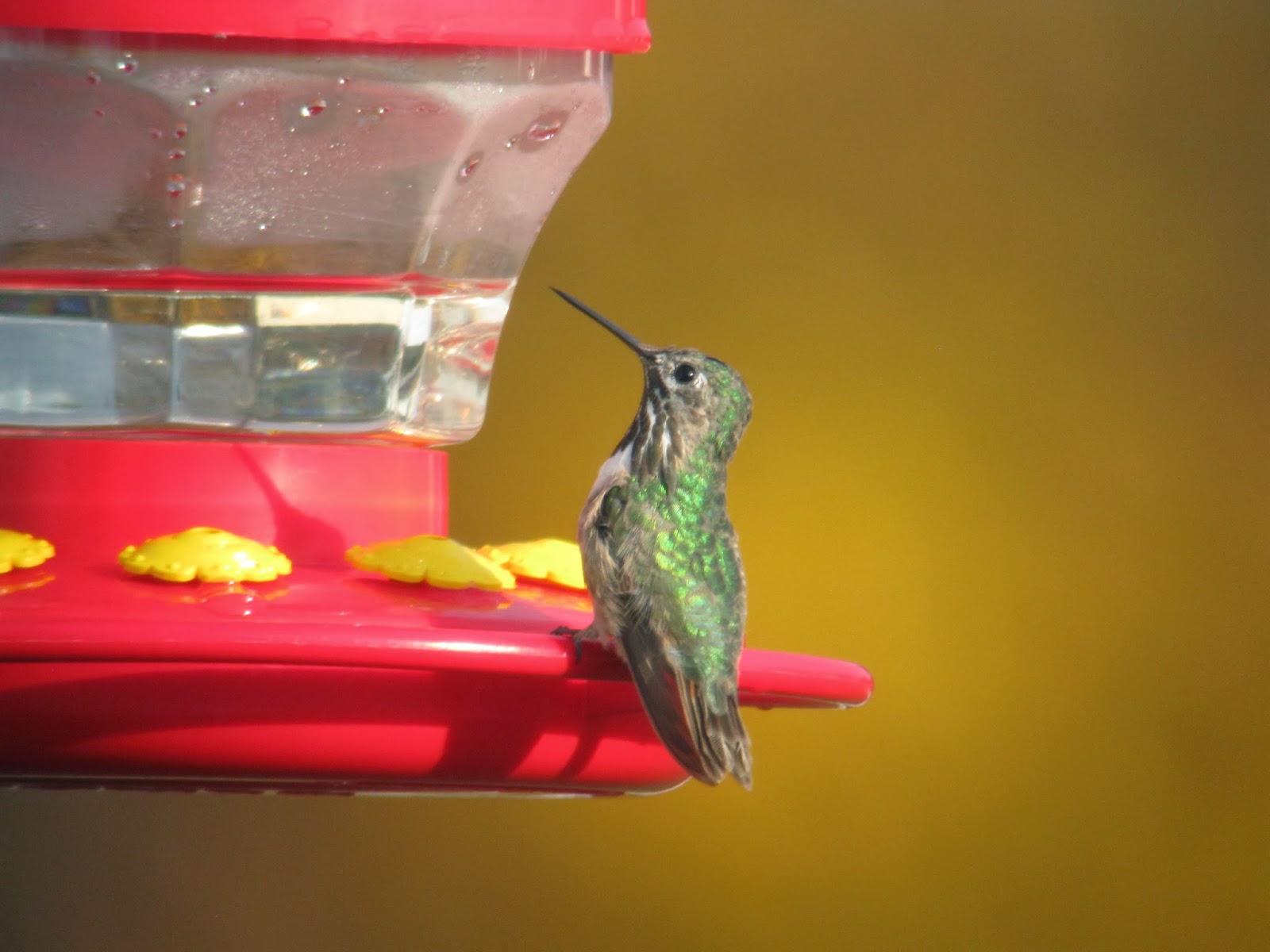 This morning Eva and I headed to Manchester, New Hampshire with hopes of seeing the Calliope Hummingbird which has been seen daily since October 6 visiting feeders at the residence of Pam and Paul Tremblay (781 South Mammoth Road). At 8:00 a.m. we arrived at our destination and were graciously welcomed by the Tremblays. Within minutes the male hummer made its appearance alighting on the feeder located in front of the house. Throughout the morning the bird tended to visit alternately one of the two feeders (the other behind the house) at 20 to 30 minute intervals. Both feeders provide birders with close range viewing and photography. Throughout our stay the number of birders steadily increased and the hummer did not fail to make appearances on schedule. By the time we decided to head back home 30 plus birders had come and gone and my guess is that none left disappointed.
This is the first New Hampshire state record for the species and a rare vagrant to the Northeast. Within the past couple weeks there have been other reports of single birds from Massachusetts and New Jersey. The Calliope Hummingbird is North America's smallest breeding bird. Its breeding range is montane habitats of the Rocky Mountains and west; winter range is southwestern Mexico. How long the Tremblays bird will remain is anyone's guess, but the longer it hangs around, its odds of survival diminish. Hopefully it will resume migrating to much more southern climes.

Many thanks to our hosts, Pam and Paul, for their generosity and patience by granting so many birders the rare opportunity of seeing this little gem.

Wednesday, October 16, 2013
Ross's Goose - Dead Creek Wildlife Management Area
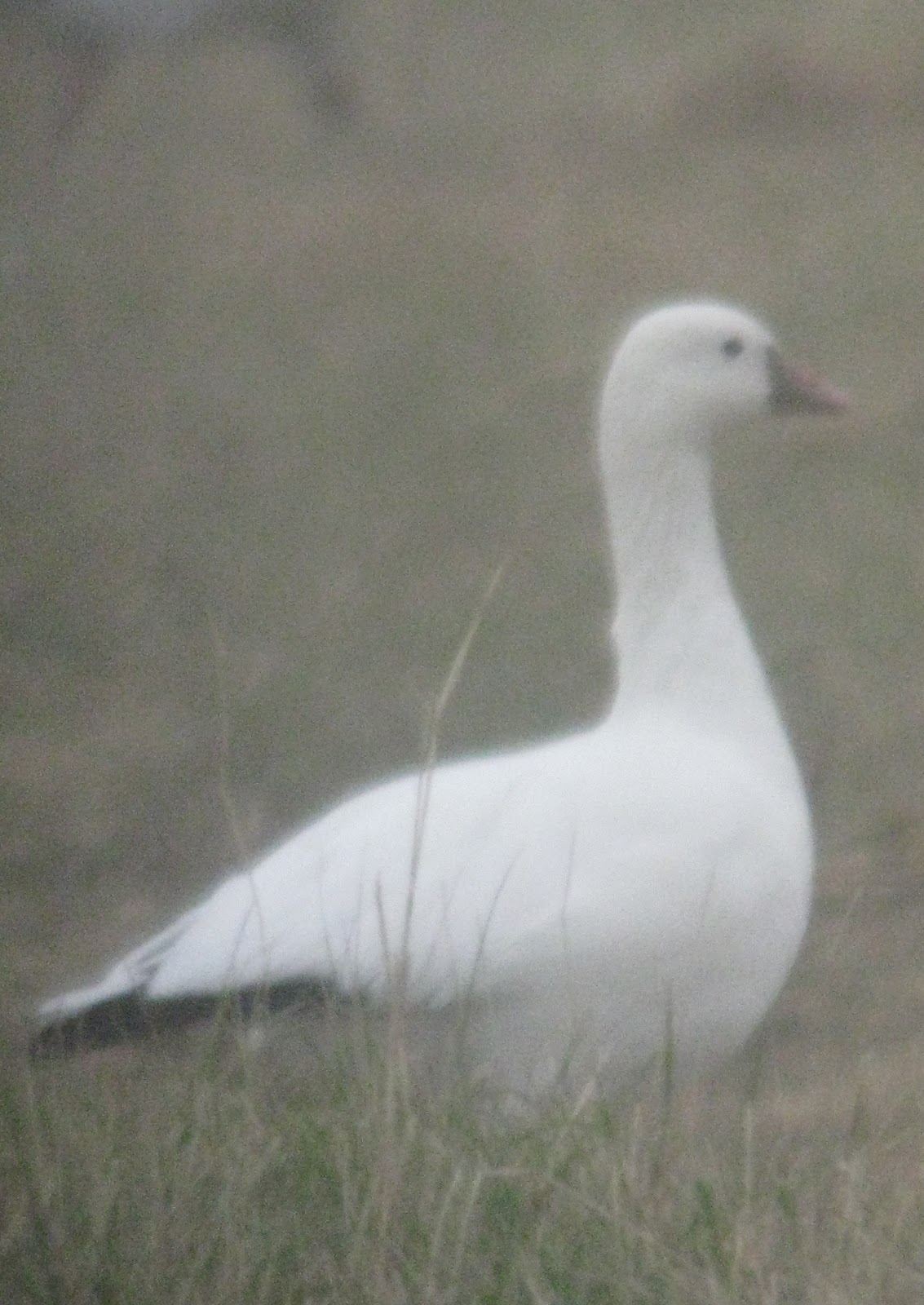
The WMA is a 2,858 acre tract located in the towns of Addison, Bridport and Panton. The Creek, seven impoundments, and associated wetlands attract a variety of waterfowl species as well as shorebirds particularly during migrations. Much of the WMA is in agricultural use (corn and hay production) which provide feed and resting areas for geese in migration. The WMA is one of the most popular birding destinations in Vermont. It is owned by the State of Vermont and managed by the Vermont Fish & Wildlife Department.


Monday, August 26, 2013
Baird's Sandpiper - North Springfield Lake
Yesterday morning (Sunday, August 25) Don Clark and I checked out the mud flats at North Springfield Lake in Springfield and Weathersfield, VT for southward bound migrating shorebirds. Viewing was from two locations overlooking the northeastern portion of the reservoir from Springweather Nature Area. Over the past several weeks there have been some interesting bird sightings: most notably three Snowy Egrets, up to five Great Egrets, and two Black-crowned Night-Herons. Both egrets were present on Sunday as well as the following shorebirds: Great Blue Heron (at least one), Green Heron (2), Killdeer (upwards of 30 or so), Solitary Sandpiper (1), Spotted Sandpiper (1), Greater Yellowlegs (2), Lesser Yellowlegs (3), Least Sandpiper (9), and Baird's Sandpiper (1).
The Baird's was the most significant sighting of the morning. Spotted feeding on Canada Goose droppings (small insects or other invertebrates?) littering the sandbar island. The island is where the Snowy Egrets tend to loaf when not foraging. The following photos were digiscoped from the overlook at a range of 100+ yards:

Above, note size comparison to Killdeer. When Baird's was seen next to Least Sandpiper, the former was decidedly larger.

Baird's back has a scaly appearance and head, neck and upper breast are washed with light brown or buff. Both above and below photos show long wing tips (primary projection and tertials extend beyond tail tip).

Below, note long, straight bill without any discernible curvature. Our bird for the most part avoided the edge of the sandbar island preferring to feed on higher, drier ground.

The Baird's was the most significant sighting of the morning. Spotted feeding on Canada Goose droppings (small insects or other invertebrates?) littering the sandbar island. The island is where the Snowy Egrets tend to loaf when not foraging. The following photos were digiscoped from the overlook at a range of 100+ yards:

Above, note size comparison to Killdeer. When Baird's was seen next to Least Sandpiper, the former was decidedly larger.

Baird's back has a scaly appearance and head, neck and upper breast are washed with light brown or buff. Both above and below photos show long wing tips (primary projection and tertials extend beyond tail tip).

Below, note long, straight bill without any discernible curvature. Our bird for the most part avoided the edge of the sandbar island preferring to feed on higher, drier ground.

Sunday, April 7, 2013
Mud Season
 Spring in Vermont is well underway, but Ole Man Winter isn't letting up on his grip without a fight. Daytime temperatures have been hovering in the 40s, occasionally climbing into the low 50s, and evenings drop back into the 20s. All this makes for some interesting back road driving...hub deep mud by early afternoon and frozen ruts by morning. Its called mud season for good reason. Where snow continues to blanket the ground, it is definitely showing age and will eventually melt away revealing of course only more mud.
 And this is also sugaring season. Maple trees have been yielding sap, bucket after bucket, while sugar houses are billowing out steam as a byproduct of boiling down the raw product to sweet ambrosia...maple syrup. Each gallon of syrup requires 40 gallons of sap and a lot of hard labor not to mention late nights. From what I hear the 2013 season is looking to be a good one which is welcome relief following last year's poor sugaring season.
.JPG) For me another sure sign of spring is the first arrival of male Redwing Blackbirds and hearing their guttural, squeaky songs, konk-ka-ree. In their wake have been the appearance of other early spring migrants such as Turkey Vultures, Common Grackles, American Woodcocks, Tree Swallows, and a variety of waterfowl. With each passing day or two a new spring migrant makes its annual appearance. Its a rite of spring and spiritual renewal after a long winter.
For me another sure sign of spring is the first arrival of male Redwing Blackbirds and hearing their guttural, squeaky songs, konk-ka-ree. In their wake have been the appearance of other early spring migrants such as Turkey Vultures, Common Grackles, American Woodcocks, Tree Swallows, and a variety of waterfowl. With each passing day or two a new spring migrant makes its annual appearance. Its a rite of spring and spiritual renewal after a long winter.The four tom Wild Turkeys that had been daily visitors to our yard gleaning seed and cracked corn from underneath the bird feeders have moved on in pursuit of mates. Just yesterday while driving we were stopped in our tracks by a hormone pumped tom standing in the road seemingly oblivious to everything except the bevy of hens fully aware of our presence.
In a few weeks the Vermont landscape will be flushed with a pallet of pastels. Forested hills breaking from winter dormancy will be flushed with pale greens and pinks with a splash of white here and there disclosing amelanchiers and viburnums in bloom. Fields and pastures will green up and many wetlands will burst with gold marsh marigolds. For me this all too brief couple weeks of spring rivals the hyped fall foliage season. Greek mythology associates spring, a time of new growth, with the nymph Chloris, so let's welcome her once again and take pleasure in her gifts.
Saturday, July 2, 2011
The Birdwatcher and the Cormorant
The heading of this post may suggest an Aesop fable communicating a moral message of some sort, and that is not too far from the truth, based on a recent encounter I had with a Double-crested Cormorant.
At least once a year I make a birding trip to The Nature Conservancy's LaPlatte River Natural Area in Shelburne, Vermont. The area is located just upstream of Shelburne Bay on Lake Champlain and is a reliable place to see Black-crowned Night-Herons, and on the bay, Caspian Terns. During the morning of this posting date I made such a trip and while walking the trail through the reserve and approaching the river shoreline, I heard quite a commotion ahead in the water. Something was frantically splashing. Initially I passed it off as a large fish, perhaps a carp spawning in the shallows, but it soon became apparent that it was a cormorant tangled in low lying tree limbs. Upon closer inspection it was evident the agitated bird was tangled in fishing line and snagged on a branch. Certainly without relief the bird would experience an agonizing death, so this "good samaritan" without much forethought decided to liberate the unfortunate critter. Well, at the time this didn't seem to be all that big a deal and certainly without much risk to the rescuer. Oh, how wrong I was.
Walking percariously out to the bird via a flimsey limb the bird naturally was freaked out by my presence and was in no mood to be cooperative. Being aware that the cormorant would make every effort to defend itself and would bite given the chance, I scoped out the situation and decided I needed to constrain it and somehow keep the bill closed while attempting to release it. I fully underestimated the situation. The speed, accuracy and power a cormorant is capable of its bill to use would become obvious. My first attempt resulted in the bill being forcefully clamped down hard on the right hand with the pointed, hooked nail of the upper mandible piercing the flesh...how tightly it held without being forced to release. It was very reminiscent of an experience I had with a large snapping turtle in my youth. And as if this first encounter with the cormorant wasn't enough I managed to get bitten at least a half dozen times on one hand and half as many again on the other. Needless to say my hands were in pain, swollen and bloodied and I was not any closer to freeing the bird. I will admit that it did pass my mind a couple times to shorten the unpleasant ordeal and somehow dispatch the bird humanely to permanently put it out of its misery and allow me to go my way.
Then two kayackers came into view. I called out to them asking if either had a knife or other sharp implement. They did not but paddled over to give assistance. Both attempted to distract the bird from me with their paddles while I worked on cutting the lines with my car keys...not the proper tool for the task. All the while the cormorant was within a neck reach of me and managed to sneak in a couple lunges at my head. Luckily, these were dodged. Eventually enough lines were cut to enable the bird to slip free of its bonds. It immediately dove and swam under water resurfacing about 10 yards away, and not so much as one guttural croak was given to express thanks to its liberators.
So as a fable is supposed to communicate a message to live by, I see there are at least two, one from the perspective of the cormorant: don't bite the hand that feeds (frees) you; and the other from the rescuer: no good deed goes unpunished or something like that. And what did I learn from this experience: (1) don't attempt to handle a cormorant without heavy leather gloves; (2) have a towel or something to cover the birds head when trying to capture and constrain it; and (3) always carry a pocket knife, something I should have remembered from Boy Scouts.
At least once a year I make a birding trip to The Nature Conservancy's LaPlatte River Natural Area in Shelburne, Vermont. The area is located just upstream of Shelburne Bay on Lake Champlain and is a reliable place to see Black-crowned Night-Herons, and on the bay, Caspian Terns. During the morning of this posting date I made such a trip and while walking the trail through the reserve and approaching the river shoreline, I heard quite a commotion ahead in the water. Something was frantically splashing. Initially I passed it off as a large fish, perhaps a carp spawning in the shallows, but it soon became apparent that it was a cormorant tangled in low lying tree limbs. Upon closer inspection it was evident the agitated bird was tangled in fishing line and snagged on a branch. Certainly without relief the bird would experience an agonizing death, so this "good samaritan" without much forethought decided to liberate the unfortunate critter. Well, at the time this didn't seem to be all that big a deal and certainly without much risk to the rescuer. Oh, how wrong I was.
Walking percariously out to the bird via a flimsey limb the bird naturally was freaked out by my presence and was in no mood to be cooperative. Being aware that the cormorant would make every effort to defend itself and would bite given the chance, I scoped out the situation and decided I needed to constrain it and somehow keep the bill closed while attempting to release it. I fully underestimated the situation. The speed, accuracy and power a cormorant is capable of its bill to use would become obvious. My first attempt resulted in the bill being forcefully clamped down hard on the right hand with the pointed, hooked nail of the upper mandible piercing the flesh...how tightly it held without being forced to release. It was very reminiscent of an experience I had with a large snapping turtle in my youth. And as if this first encounter with the cormorant wasn't enough I managed to get bitten at least a half dozen times on one hand and half as many again on the other. Needless to say my hands were in pain, swollen and bloodied and I was not any closer to freeing the bird. I will admit that it did pass my mind a couple times to shorten the unpleasant ordeal and somehow dispatch the bird humanely to permanently put it out of its misery and allow me to go my way.
Then two kayackers came into view. I called out to them asking if either had a knife or other sharp implement. They did not but paddled over to give assistance. Both attempted to distract the bird from me with their paddles while I worked on cutting the lines with my car keys...not the proper tool for the task. All the while the cormorant was within a neck reach of me and managed to sneak in a couple lunges at my head. Luckily, these were dodged. Eventually enough lines were cut to enable the bird to slip free of its bonds. It immediately dove and swam under water resurfacing about 10 yards away, and not so much as one guttural croak was given to express thanks to its liberators.
So as a fable is supposed to communicate a message to live by, I see there are at least two, one from the perspective of the cormorant: don't bite the hand that feeds (frees) you; and the other from the rescuer: no good deed goes unpunished or something like that. And what did I learn from this experience: (1) don't attempt to handle a cormorant without heavy leather gloves; (2) have a towel or something to cover the birds head when trying to capture and constrain it; and (3) always carry a pocket knife, something I should have remembered from Boy Scouts.
Subscribe to:
Posts (Atom)