 |
| Vermont Fish & Wildlife Department photo. |

Saturday, March 22, 2014
Bear Alert!

Sunday, March 16, 2014
Turners Falls Waterfowl
After seeing recent reports of a Canvasback and a Redhead on the Connecticut River and Barton's Cove in Turners Falls, Massachusetts, I drove down to check out the action being last week's late season major snow storm and subsequent cold temperatures greatly limit birding prospects in the vicinity of home.
The river immediately upstream of Turners Falls Dam was found to be largely ice free with good numbers of waterfowl including the following species: Canada Goose, Mute Swan, Mallard, Canvasback, Redhead, Ring-necked Duck, Greater Scaup, Long-tailed Duck, Bufflehead, Common Goldeneye, Common Merganser, and Red-breasted Merganser. While there I was told by another birder that three Canvasbacks were present earlier in the day, but only two remained by the time of my arrival. The Canvasbacks and the Redhead (all males) were napping the entire time and not cooperating to be digiscoped. Even though their heads were snuggled into their backs, identification was straight forward. Note in the photo below the light gray back and sides of the Readhead contrasting with the very white back and sides of the Canvasback.
The river immediately upstream of Turners Falls Dam was found to be largely ice free with good numbers of waterfowl including the following species: Canada Goose, Mute Swan, Mallard, Canvasback, Redhead, Ring-necked Duck, Greater Scaup, Long-tailed Duck, Bufflehead, Common Goldeneye, Common Merganser, and Red-breasted Merganser. While there I was told by another birder that three Canvasbacks were present earlier in the day, but only two remained by the time of my arrival. The Canvasbacks and the Redhead (all males) were napping the entire time and not cooperating to be digiscoped. Even though their heads were snuggled into their backs, identification was straight forward. Note in the photo below the light gray back and sides of the Readhead contrasting with the very white back and sides of the Canvasback.
 |
| Redhead, left; Canvasback, right. |
 |
| Left to right in foreground, Canvasback and Redhead. Ring-necked Ducks to rear and right. |
Tuesday, March 11, 2014
Winter or Spring: Which Is It?
 |
| Ludlow, VT. March 9, 2014. |
 |
| Late winter/early spring Wooly Bear (Isabella Moth) caterpillar. |
Saturday, February 8, 2014
Curing the Midwinter Birding Doldrums
Having just passed the midpoint of winter, halfway between winter solstice and spring equinox, but little else giving hope of an early spring arrival other than increasing day length, I'm passing the season enjoying birds visiting the feeders and checking out the few nearby spots that offer some potential for interesting birdwatching. Unfortunately this is the winter birding doldrums. So, I am enjoying the comforting heat of the woodstove and am reminded of our getaway last February to northern Florida for a mini-family reunion in St. Augustine and some personal time to seek out a couple specialty birds. This took me to Ocala National Forest in the north-central part of the state. Covering over 380,000 acres, it is the most southern national forest in the continental United States and constitutes the world's largest remaining contiguous sand pine scrub ecosystem.
One of my quests was the federally endangered Red-cockaded Woodpecker, a keystone species of mature longleaf pine forests. Luckily I succeeded in finding at least two by keeping a close watch on a clump of marked nesting trees observable from the road and listening for any vocalizations.
 |
| Female Red-cockaded Woodpecker at entrance to nesting cavity. |
 |
| Cluster of marked Red-cockaded Woodpecker nesting trees in longleaf pine forest, Ocala National Forest. |
Next on my list was the endemic Florida Scrub-Jay. Although a brief visit to Merritt Island National Wildlife Refuge located adjacent to the Kennedy Space Center produced one jay, the mother load was definitely the Big Scrub in Ocala National Forest. The Big Scrub is a sand pine scrub ecosystem which makes up about 70% of the national forest. It is a fire-dependent system that provides habitats for a high diversity of rare, threatened and endangered animal and plant species. It is accessible on foot via the Yearling Trail.
 |
| A pair of Florida Scrub-Jays in the Big Scrub. |
 |
| Banded Florida Scrub-Jay, Merritt Island National Wildlife Refuge. |
 |
| The Yearling Trail through the Big Scrub. Note jays perched at the top of each of the two right-hand tree snags. |
 |
| "Yellow-eyed" Eastern Towhee, a common inhabitant of the Big Scrub. |
This harmless Eastern Hognose Snake was encountered as it was crossing a forest road. A nonvenomous species that resorts to a routine of bluff when threatened. Its first move is give the illusion of being larger than it really is by inflating the body, spreading the head for a "hooded" effect, hissing and striking. If that does ward of the intruder, well then roll over and play dead: mouth gaped open, tongue extended, cloaca inverted, and abdomen sunken. One minor flaw with this ruse is that if it is turned right side up, the snake will roll over and play dead again. Left alone and sensing danger has passed, it will right itself and continue on its way.
 |
| Eastern Hognose Snake. |
 |
| Same hognose snake convincingly playing "dead." |
Wednesday, February 5, 2014
Timberdoodle Shows Off Dance Moves
I'll venture to guess that virtually every birdwatcher has seen the comical video, first posted on YouTube back in 2006, of a male Red-capped Manakin performing its "moon walk" mating dance dubbed to Michael Jackson's "Billie Jean." Well, here's another featuring in this case an American Woodcock, a.k.a. timberdoodle. Unlike that of the manakin, the woodcock's fancy footwork has been suggested to be a feeding tactic used to agitate earthworm activity in the soil enabling the bird to locate its quarry. Earthworms are reported to comprise about 60% of its diet with the remaining balance being other assorted invertebrates. Feeding is done by the bird repeatedly penetrating moist, rich soil with its long (2.5-3.0") bill. The bill has a flexible tip that enables it to clasp a worm underground without the need to open the entire bill. Just what the woodcock featured in this Dance video is trying to accomplish, only it knows...perhaps rehearsing its routine for an upcoming "ice dancing" event. Anyway, while watching the clip I dare you not to be pleasantly entertained.
The video was recorded by Bill Hubick, who along with Jim Brighton have launched the Maryland Biodiversity Project, an endeavor with the goal of cataloging every living thing found in Maryland at a single website: marylandbiodiversity.com.
Sunday, November 24, 2013
Cats & Birds: A Longtime Conservation Struggle
The impact of free-ranging domestic and feral cats on bird populations has been researched and reported in the media for at least several decades. And, at least as old, are the heated debates between cat defenders and bird conservationists. One of the most current published studies of cat predation (Loss, S. R., T. Will, and P. P. Marra. 2013. The impact of free-ranging domestic cats on wildlife of the United States. Nature Communications 4:1396) estimated bird deaths attributed to cat predation to be in the range of 1.4 to 3.7 billion annually. Feral cats attributed to the majority of bird deaths.
Recently, while perusing biennial reports of the Vermont State Fish and Game Commissioner, I came across the following article in the 22nd Biennial Report, Fiscal Year 1914, reprinted verbatim below. The commissioner at the time was John W. Titcomb. He stated:
"The reader of the foregoing will acknowledge that the birds are a very important economic factor in agriculture and that every possible effort should be made to increase their numbers.
"Mr. Edward H. Forbush, state ornithologist of Massachusetts, says that a mature cat in good hunting grounds kills on average fifty birds a year. "If we assume, however, that the average cat on the farm kills but ten birds a year, and that there are two cats on each farm in Massachusetts, we have, in round numbers, seventy thousand cats killing seven hundred thousand birds annually."
"Mr. Forbush has merely counted the destruction caused by cats in Massachusetts. Adding the enormous number of village and city cats, many of which have good opportunity for catching birds and their young , the havoc wrought is appalling. It therefore behooves every right-minded citizen and his family to keep the family house pet at home and well fed. To a large degree cats may be trained not to kill birds. Everyone should guard against stray cats which are often deserted by families moving from one locality to another and are obliged to roam the forests and fields to get a living.
"It has been proposed in some states to license cats. Such a radical step seems undesirable, if every bird lover and those who are interested in the economic value of birds take warning to see that the family "tabby" is not allowed to roam at large.
"Those who are really bird lovers and want to have bird nesting close to the house should try the experiment of dispensing with the family cat for one summer and note the increase in bird life about the garden."
Obviously, measures to reduce the cat predation problem have been discussed at least 100 years. Recommending responsible cat owners confine their pets to indoors rather letting them to free-range is nothing new but nevertheless not accepted as much as it should be.
Our own house cat, Simone, has never been permitted access to the out of doors, therefore deprived opportunities to prey on birds or worse yet to fall victim to a predator-prey role reversal, i.e. being a meal for a coyote or fisher. Despite not being allowed to pursue her natural killer instinct she seems content to watch birds frequenting the feeders and knowing that her food bowl will be filled on schedule daily.
Saturday, November 2, 2013
Calliope Hummingbird
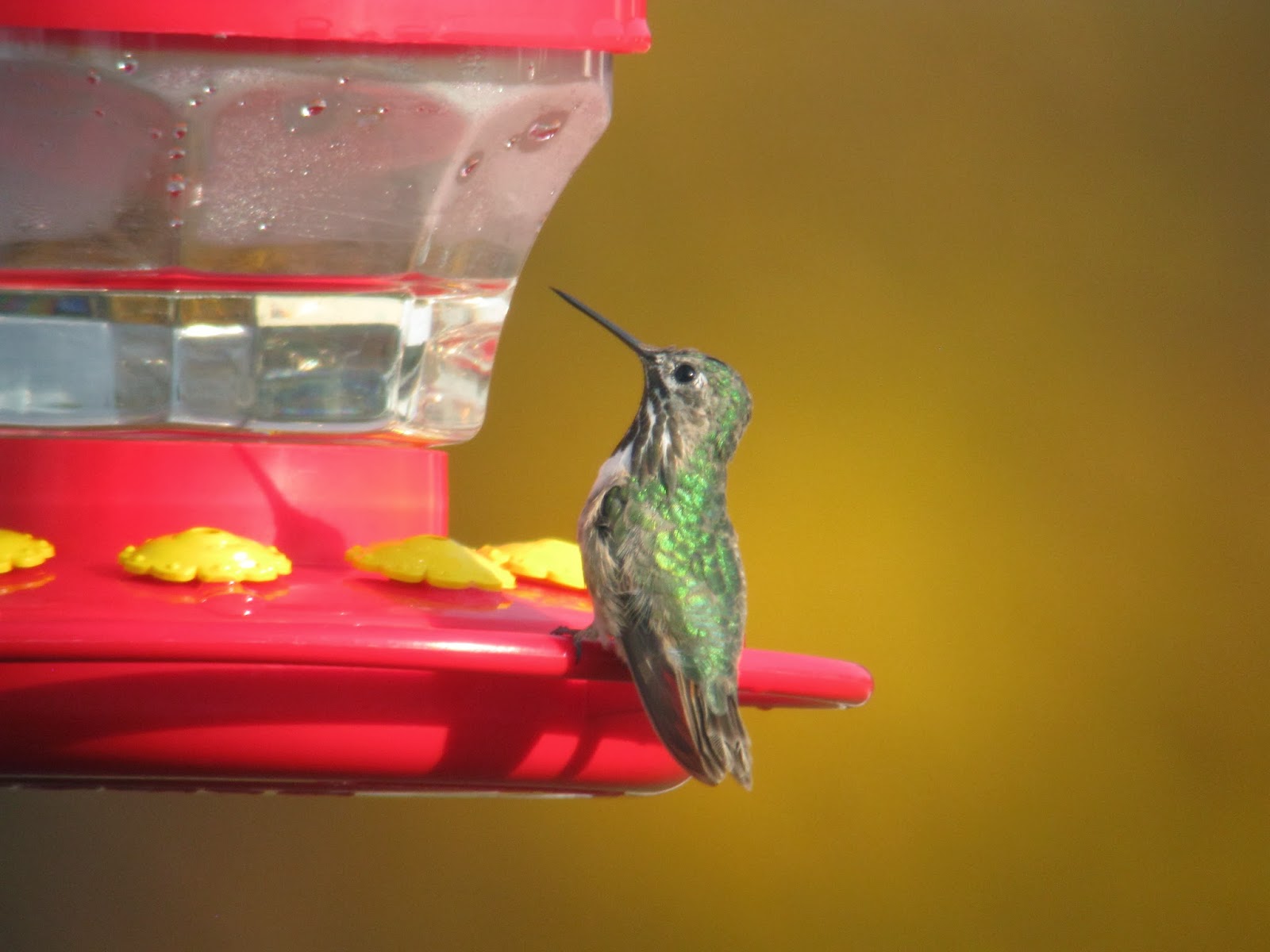 This morning Eva and I headed to Manchester, New Hampshire with hopes of seeing the Calliope Hummingbird which has been seen daily since October 6 visiting feeders at the residence of Pam and Paul Tremblay (781 South Mammoth Road). At 8:00 a.m. we arrived at our destination and were graciously welcomed by the Tremblays. Within minutes the male hummer made its appearance alighting on the feeder located in front of the house. Throughout the morning the bird tended to visit alternately one of the two feeders (the other behind the house) at 20 to 30 minute intervals. Both feeders provide birders with close range viewing and photography. Throughout our stay the number of birders steadily increased and the hummer did not fail to make appearances on schedule. By the time we decided to head back home 30 plus birders had come and gone and my guess is that none left disappointed.

This is the first New Hampshire state record for the species and a rare vagrant to the Northeast. Within the past couple weeks there have been other reports of single birds from Massachusetts and New Jersey. The Calliope Hummingbird is North America's smallest breeding bird. Its breeding range is montane habitats of the Rocky Mountains and west; winter range is southwestern Mexico. How long the Tremblays bird will remain is anyone's guess, but the longer it hangs around, its odds of survival diminish. Hopefully it will resume migrating to much more southern climes.

Many thanks to our hosts, Pam and Paul, for their generosity and patience by granting so many birders the rare opportunity of seeing this little gem.

Subscribe to:
Posts (Atom)