Wednesday, May 19, 2010

April 24-May 1.  The week in New Mexico provided several birding opportunities.  Most notable was a day (April 27) spent at Bosque del Apache National Wildlife Refuge located in the Middle Rio Grande Valley about 20 miles south of Socorro.  Any birding trip to New Mexico without stopping into the refuge is a significant oversight.  The refuge is reknown for its thousands of wintering Sandhill Cranes and Snow Geese.  Even though the cranes and geese departed for their northern breeding grounds weeks ago, there was much to be seen as other winter migrants lingered on and new spring arrivals were trickling in.

New Mexico at this time of year is a season of transition as well as contrasts: the thread of riparian woodlands intersecting the northern Chihuahuan desert were the  leafing out and daytime temperatures in the Valley were in the low 80s falling into the 40s and 50s during the night.  On the other hand, add another 3,000 ft elevation and the temperatures are a comfortable 70s with nights possibly falling to freezing or even below.  We were surprised upon rising morning to 27 degrees and snow blanketing the ground.  The sugar solution in the hummer feeders was frozen none several Broad-tailed Hummingbirds were actively flying about and checking out the feeders.   That was a sight we are definitely not accustomed to seeing in northern New England. 

The Bosque, which means woodlands, measures 57,191 acres in size and is comprised of riparian cottonwood bosques, desert scrub and canyons, freshwater impoundments and marshes, and agricultural lands managed by the U. S. Fish and Wildlife Service for a diveristy of wildlife and plant communities.  The refuge includes elevations ranging from 4,500 to 6,272 ft above sea level.

The single full day I spent birding the refuge core area (including 15 miles of roads encircling the seasonal and permanent ponds and wetlands) produced 73 species listed below.  Many passerine species that I have seen at this time of year on previous visits were missed altogether.  But given the size of the refuge, much of it open to birders, and my own time limitations, it is not at all surprising that species went unseen.  Digiscoped images of some of my sightings are at the end of this post.

Snow Goose, white morph
Ross's Goose
Canada Goose
Gadwall
American Wigeon
Mallard
Blue-winged Teal
Cinnamon Teal
Northern Shoveler
Northern Pintail
Green-winged Teal
Redhead
Ring-necked Duck
Lesser Scaup
Bufflehead
Common Merganser
Ruddy Duck
Ring-necked Pheasant
Wild Turkey
Gambel's Quail
Pied-billed Grebe
Eared Grebe
Western Grebe
Neotropic Cormorant
Great Blue Heron
Great Egret
Snowy Egret
Cattle Egret
Black-crowned Night-Heron
White-faced Ibis
Turkey Vulture
Osprey
Northern Harrier
Red-tailed Hawk
Peregrine Falcon
Virginia Rail
American Coot
Killdeer
Black-necked Stilt
American Avocet
Lesser Yellowlegs
Long-billed Dowitcher
Wilson's Phalarope
White-winged Dove
Mourning Dove
Greater Roadrunner
Lesser Nighthawk
Black-chinned Hummingbird
Black Phoebe
Say's Phoebe
Ash-throated Flycatcher
Western Kingbird
Chihuahuan Raven
Tree Swallow
Northern Rough-winged Swallow
Bank Swallow
Cliff Swallow
Barn Swallow
Bushtit
Bewick's Wren
Blue-gray Gnatcatcher
American Robin
Yellow Warbler
Yellow-rumped Warbler, Audubon's and Myrtle subspecies
Summer Tanager
Spotted Towhee
Chipping Sparrow
Lark Sparrow
Dark-eyed Junco, Gray-headed and Pink-sided subspecies
Black-headed Grosbeak
Red-winged Blackbird
Brewer's Blackbird
Bullock's Oriole
House Finch

Fortunately, two white geese, a Snow and a Ross's, had not left for the north and offered close-up side-by-side comparisons.  The size difference between the two birds was clearly evident.  While the head structure of the Snow Goose had sharply angular features that of the Ross's Goose seemed more akin to a Beatrix Potter illustration: soft, gentle and diminutive.  To this observer the so-called "grin patch" of the Snow Goose bill is more sneer-like.

Above photos (top to bottom):

  • Male Gambel's Quail sporting characteristic 1950s pompadour.
  • Snow Goose.
  • Ross's Goose.
  • Cinnamon Teal, male and female.
  • Redhead, male.
  • Eared Grebe.
  • Neotropic Comorant in breeding plumage.
  • White-faced Ibis.
  • American Avocets.
  • Black Phoebe.
  • Western Kingbird.
  • "Audubon's" Yellow-rumped Warbler, male.
  • Rising full moon over the Bosque.  Note the three dark specks on its face...swallows.

Friday, April 16, 2010

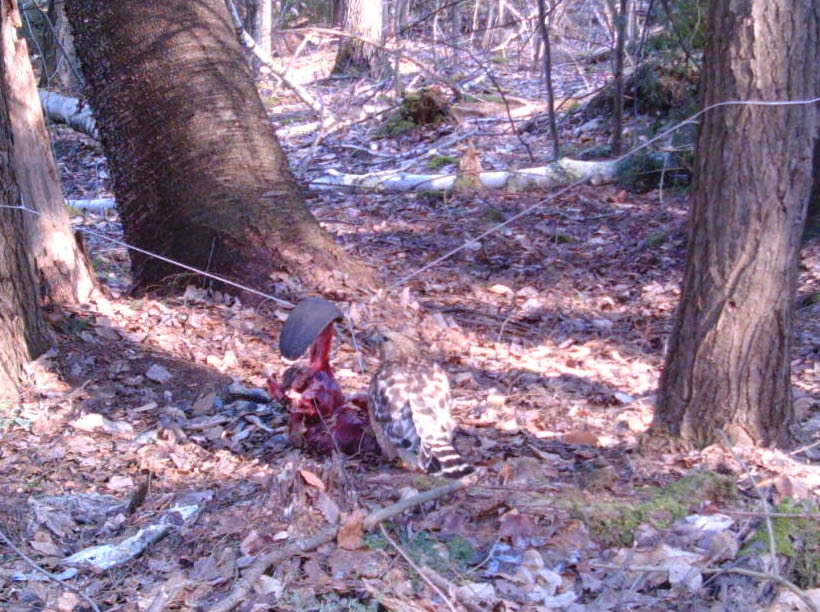
Do Red-shouldered Hawks Feed on Beavers?

This is a late post but recently work colleague, Shawn Good, shared with me images of a Red-shouldered Hawk he took with a digital trail camera on his property in Pittsford, Vermont.  He used a  beaver carcass for bait expecting to document the usual wildlife that might be expected in the local area: bear (bottom photo), coyote, bobcat, fisher and the like.  But he certainly did not anticipate a hawk.  The middle photo has been cropped to provide a little closer view of the bird. 

I did not think Red-shouldered Hawks typically fed on carrion, so I looked into several information sources on the web including the Peregrine Fund www.peregrinefund.org/explore_raptors/hawks/redshldr.html and saw that small mammals, reptiles and amphibians, birds and insects are the staple of the hawk's diet with no mention of carrion.  Considering the date the photos were taken, March 26, I will speculate that the beaver carcass was a welcome meal after a migration flight and that the usual food items might be in short supply or at least more challenging to capture in early spring.   So I guess the answer to the question is yes under certain circumstances.
  

Sunday, April 11, 2010

Common Teal at Herrick's Cove

Sunday, April 11, 2010. While scanning a flock of 44 Green-winged Teal Anas crecca carolinensis this morning at Herrick's Cove (mouth of Williams River in Rockingham, VT) to my surprise I sighted a mature male Common Teal Anas c. crecca. This is the second year in a row that I have had the Eurasian or nominate race at this location, and this is the third sighting for Herrick's Cove within the past four years. The 2007 bird was a first state record of the subspecies in VT. All sightings have occurred in April. The drakes were putting on a nice show of courtship behavior. Below are a few digiscoped images of this year's bird.


Sunday, March 28, 2010

A Method for Safe Keeping Your Digiscoping Camera in the Field

Digiscoping, the technique of photographing wildlife at a distance with a digital point-and-shoot camera held to the eyepiece of a field spotting scope, has gained popularity since it was first discovered somewhat accidentally by Laurence Poh, a Malaysian birdwatcher, back in 1999. The method enables nature observers to easily record photographs of wildlife subjects without investing in more costly telephotography equipment. Assuming you have already purchased a quality scope, all that is lacking to digiscope is a comparatively less expensive digital camera and a heavy dose of patience. I started digiscoping over two years ago, have taken a large number of satisfying photos but not having had much previous technical photographic experience, my techniques continue to develop. There is a lot of information available via internet sources suggesting basic equipment needs and techniques (e.g. Mike's Digiscoping http//birddigiscoper.blogspot.com and Eagle Optics www.eagleoptics.com/articles/digiscoping). Readers are encouraged to check these sites out if they have not done so previously.


Birding as with any other field endeavor has its basic equipment requirements (binoculars, scope, field guide, notepad and pencil) in addition to all the ancillary things we individually "need" and stuff into our field jacket pockets and/or day pack. I have long suffered from equipment overload and digiscoping (the camera and spare batteries) has added to it. The number of times I have had a subject targeted in my scope and have fumbled to retrieve the camera and prep it to shoot an image only to have the bird drift out of sight or worse yet disappear altogether, well, are too many to want to remind myself of. With regard to storing the camera safely in the field and at the same time have it handy when needed most is something I have been looking at for a better solution.

I think I have finally found it. The camera when not in use is stored in a sturdy case attached by straps to one of the scope tripod legs (Figure 1 below). The case is a Model 1010 Micro manufactured by Pelican Products. It is strong, durable and water resistant. The interior is padded with a rubber insert that accepts a camera having maximum dimensions of 4" x 2.5" x 1.25." The case snaps firmly shut and is moulded with two belt loops. Two 24" long, 3/4" wide nylon straps each fitted with a ladder-type slide buckle at one end are used to amount the case to the tripod. Total cost of these items is less than $20 (case $15; straps $2.50).

Assembly of the components and attachment to the tripod is simple. Connect the two straps by the buckles end to end to make one continuous loop. Insert an end of the doubled over strap through one of the belt loops and repeat for the other belt loop (Figure 2). The strap should extend between the two belt loops across the back of the case. Stretching out the strap creates a figure 8 (Figure 3). The strap loops are then slid over a tripod leg and cinched up real tight to prevent the case from sliding off or moving sideways. I found that attaching this to one of the legs with a foam hand grip provides the greatest stability.

Advantges of this setup are: (1) you know exactly where your camera is and is handy to get to when you need it, and (2) when stored in the case it is protected from bumps, scratches and moisture.

Monday, February 22, 2010

Lake Champlain Ivory Gull

Monday, February 22, 2010. As we near the end of winter I believe the general opinion of most Vermont birders is the season has so far been anything but remarkable save the two Northern Hawk-Owls in Ferdinand and Derby. However, last Friday's discovery of an adult Ivory Gull on northern Lake Champlain appears to have caused a long awaited stir on both sides of the Vermont-New York border. The gull was first sighted by Pat Jones near the east end of the Route 2 Bridge between Alburgh, VT and Rouses Point, New York.

According to the VTBIRD listerserve Saturday postings reported the bird to be frequenting Kelly Bay in VT just south of the bridge where it was scavenging on fish caught and discarded by ice fishermen. I was unable to get up there until Sunday morning and by that time it had moved to the NY side of the lake north of the breakwater at the terminus of Stony Brook Road and south of Rouses Point. Upon my arrival several birders, including Bryan Pfeiffer, were there enjoying views of the gull. It was then standing at at the edge of the ice sheet several 100 yards from the viewing spot where it remained for nearly an hour. As word was getting out via listserves, twitters, etc. a steady stream of anxious birders was developing for a glimpse and/or photograph of this rarity from above the Arctic Circle.

Like Kelly Bay the Rouses Point location is popular with ice fishermen and where there are fishermen a gull might expect to find its next meal and so it did. Spotting a large Chain Pickerel on the ice the gull flew over and settled among the ice fishing activity and approaching birders. A nearby Yellow Perch enventually redirected its attention and was promptly gulped down (photos below).

This is the second Ivory Gull, both adult birds, I have seen. The first was just last winter at Plymouth, Massachusetts. I am struck by the intense whiteness of the adult birds and when on a snowy background how easily it would disappear if not for its jet black eyes and legs. In flight adult Ivory Gulls are almost ghostly.

According to my copy of Birdwatching in Vermont (Murin and Pfeiffer 2002) this is the fifth record of Ivory Gull in VT, all from the Lake Champlain area. The two earliest records, April 1982 and March 1983, are considered "hypothetical" sightings by the Vermont Bird records Committee given the lack of confirming identification evidence. The other two records are from January and November 2000 and were first winter and first summer birds, respectively.

Even though the appearance of such a rarity wherever one may show up south of Canada is cause for much excitement within the birding community, the recent occurrences of Ivory Gulls well outside their normal winter range raises suspicions that all may not be as it should be. Far flung vagrants this winter include an Ivory Gull at Cape May, New Jersey (November-December 2009) and an astounding sighting at West Point, Georgia in January of this year. Ivory Gulls not unlike Polar Bears to which it is often associated is an animal of the Arctic ice pack. It is dependent on the interface of sea ice and open water for the fish it feeds on and to some extent the remains of seal carcasses left after Polar Bear kills.

Current IUCN conservation status of Ivory Gull is near threatened, while the Canadian population has been designated endangered. There the number of breeding birds has been reported to have declined 80% since the early 1980s. This has fostered speculation that the species may be nearing the brink of extinction. Scientists who study Ivory Gulls are more guarded in their prognostications since so little is known of populations throughout the species range and factors that may influence them. That said, Ivory Gulls have been found to have some of the highest levels of contaminants in their body tissues and are experiencing habitat loss as a result of the shrinking ice shield assigned to global climate change. Other threats include disturbance of nesting birds from human activities and predation.

So as I admired the gull through through the scope and snapped off photos I could not help wonder what the future of this particular gull was or more importantly its species. Will it become another species to go extinct during my lifetime as a result of human kind's impacts on the natural environment or will it manage to adapt somehow? I suppose time will tell but this is little consolation as we continue to rapidly change Earth's environment and all its life faces an uncertain future.

1. Gull finds a 5-6 inch Yellow Perch discarded on ice.

2. With a little toss in the air, the gull positions the fish head first into its mouth.

3. And now, the fish is about to be swallowed whole spiny fins and all.

Information sources:

COSEWIC (Committee on the Status of Endangered Wildlife in Canada). 2006. Assessment and update status report on the ivory gull Pagophila eburnea in Canada. www.sararegistry.gc.ca/virtual_sara/files/cosewic/sr_ivory_gull_e.pdf.

Gilchrist, H. G., and M. L. Mallory. 2005. Declines in abundance and distribution of the ivory gull (Pagophila eburnea) in Arctic Canada. Biological Conservation 121(2):303-309.

IUCN (International Union for Conservation of Nature). Ivory gull (Pagophila eburnea). www.iucnredlist.org/apps/redlist/details/144228/0.

Thursday, February 11, 2010

Northern Hawk-Owl

Sunday, February 7. After seeing reports over the past several weeks of the two Northern Hawk-Owls wintering in Vermont's Northeast Kingdom, I decided to check out the bird in Ferdinand. Arriving at about noon and parking my vehicle at the pull-off on Route 105 I only had to walk 30 yards or so on the snowmobile trail before spotting the owl perched low in a small tree next to the railroad tracks. Not having my camera with me I walked back to the vehicle to get it and in the meantime several snowmobiles sped past the bird causing it take flight and land at the very top of a tall spruce located a bit further down the trail and within a short distance of the Nulhegan River. Range, sight angle and lighting were not the best for digiscoping, but then the owl made a bee line for the shoulder of the tracks setting on the snow only briefly before flying to a nearby dead snag tree. There, I was able to snap off a few shots, two of which I have posted here. I suspected the owl possibly saw a potential meal and made an attempt to get it, but with binocs to my eyes as it flew to and sat in the snag I saw nothing out of the ordinary. Not until I got back home, downloaded the photos and was going through the images did I notice the owl indeed had a successful hunt. In the photo below you will see the rear half of a vole visibly in its talons. That was certainly an unexpected find making the three hour drive to northern Vermont all the more rewarding.


The owl is east of Island Pond and 2.5 miles further east of the John Boyland State Airport on Route 105. A snowmobile crosses the highway at a large pull-off on the north side of the road.

Sunday, January 17, 2010

January 16 N. H. Coastal Birding

Following a very cold start to the New Year that gripped the eastern half of the U. S. in a deep freeze extending well into the Deep South, a January thaw finally has brought some relief and with it has dashed any excuses not to spend more time outdoors during this all too brief respite from winter. Taking advantage of the opportunity Eva and I headed out to the New Hampshire coast for some winter birding.

Our first stop was in Barrington, N. H. where a Sooty Fox Sparrow, a coastal Alaska and British Columbia race, has been hanging out for several weeks at feeders on Al Wood Drive and was seen as recently as the preceeding day. We did not arrive there until late morning and there was little bird activity to be seen apart from a few Black-capped Chickadees and Dark-eyed Juncos. The sparrow's visits have been reported to be brief and sporadic.

So rather than spend too much of the day waiting for it to show we continued toward the coast and stopped next at Odiorne Point State Park in Rye, where a gray morph Eastern Screech Owl (above) has been present and viewed by many over the past several weeks. Not to be disappointed upon our arrival the bird was sitting at the entrance of its posted tree cavity next to Route 1A just north of the park entrance apparently basking in the warm sunlight and seemingly oblivious to the band of birders aiming all sorts of bincoculars, spotting scopes and telescopic cameras at it. However, what did catch the owl's attention causing it to take refuge into the cavity was a Red-tailed Hawk that flew into an adjacent tree on the opposite side of the highway.

In addition to the owl and hawk a variety of wintering waterfowl were observed off Odiorne Point including American Black Ducks, Common Eiders, Surf and White-winged scoters, Long-tailed Ducks, Common Goldeneyes, Red-breasted Mergansers, Common and Red-throated loons, Horned and Red-necked grebes (photos below). Many of these as well as others (Ring-billed, Herring and Great Black-backed gulls) were spotted as we continued south via Route 1A. We were unable to locate the Barrow's Goldeneye at Great Boars Head.

Along the way we encountered at one of our many stops local birder Len Medlock, who informed us of the Glaucous Gull at the Yankee Fishermen's Cooperative in Seabrook. Generally the Coop and Hampton Harbor are swamped with gulls making picking a particular one out of the many more abundant species a challenge; however, the Glaucous Gull (below) was spotted with no effort as it stood at the water edge along with a few Herring and Great Black-backed gulls, all within close view of the visitor center parking lot. What a spendid looking subadult bird (partial PA3 molt?).

As the light of day was about to vanish below the western horizon we wrapped up the day watching a group of 22 Harbor Seals hauled out on exposed rocks just offshore. The high temperature for the day at Rye was 47 degrees, about 15 degrees warmer than the previous daytime high reported for the month so far this year. Yes, there will be more winter yet, but we find solice in the lengthening daylight hours and the eventual return of spring and along with it bird migrations.

P. S. I see posted on the NH listserve that the Sooty Fox Sparrow was seen and photgraphed by others (around 1:30 pm) after we departed. Oh well, you win some and lose some.