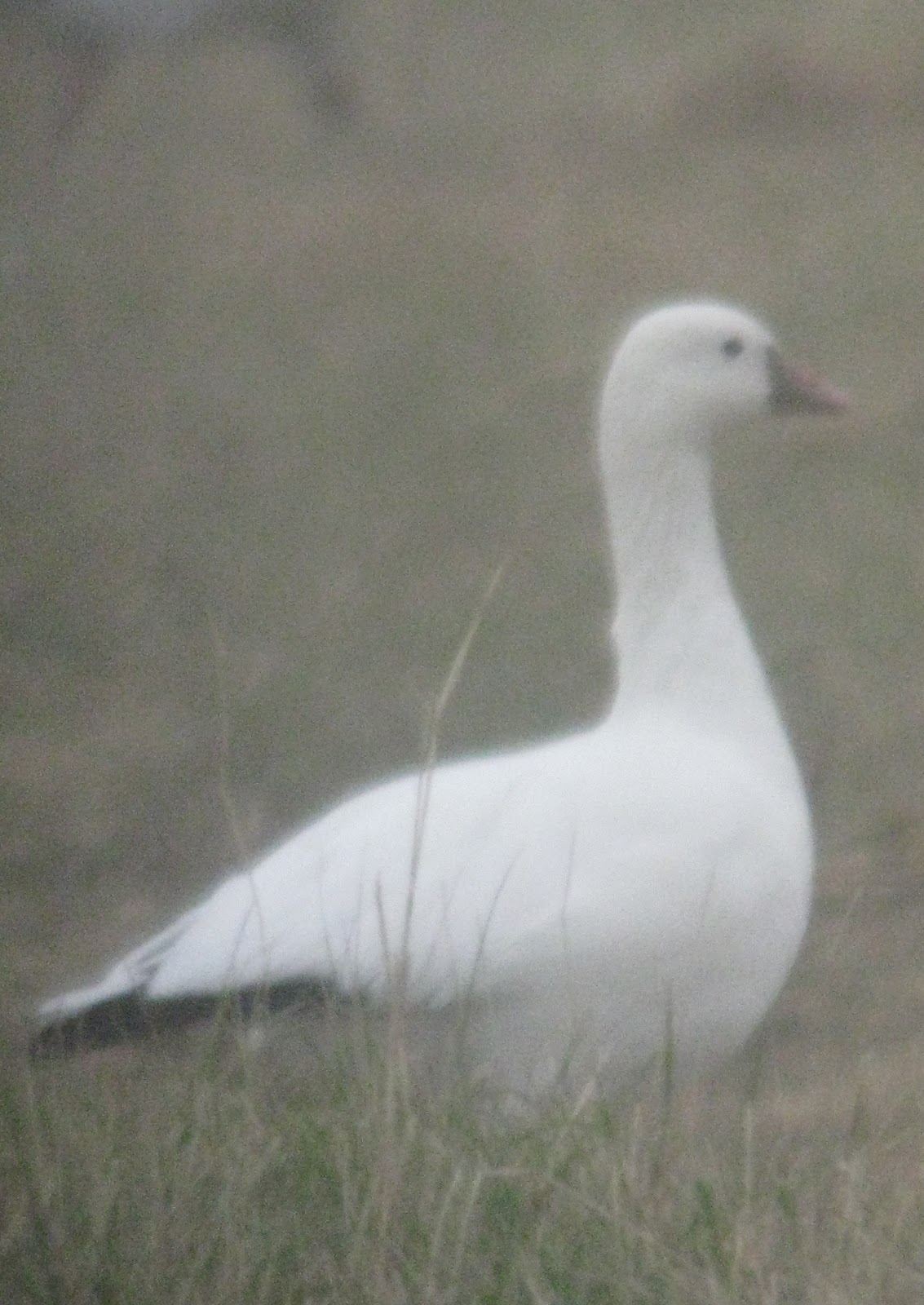
On Monday, October 15 this Ross's Goose was spotted amidst several thousand Snow Geese at the Dead Creek Wildlife Management Area (WMA) goose viewing area off VT Route 17 in Addison. The species is a very uncommon migrant in the state and, if it is to be seen, it is most likely to be at Dead Creek.
The WMA is a 2,858 acre tract located in the towns of Addison, Bridport and Panton. The Creek, seven impoundments, and associated wetlands attract a variety of waterfowl species as well as shorebirds particularly during migrations. Much of the WMA is in agricultural use (corn and hay production) which provide feed and resting areas for geese in migration. The WMA is one of the most popular birding destinations in Vermont. It is owned by the State of Vermont and managed by the Vermont Fish & Wildlife Department.
Wednesday, October 16, 2013
Monday, August 26, 2013
Baird's Sandpiper - North Springfield Lake
Yesterday morning (Sunday, August 25) Don Clark and I checked out the mud flats at North Springfield Lake in Springfield and Weathersfield, VT for southward bound migrating shorebirds. Viewing was from two locations overlooking the northeastern portion of the reservoir from Springweather Nature Area. Over the past several weeks there have been some interesting bird sightings: most notably three Snowy Egrets, up to five Great Egrets, and two Black-crowned Night-Herons. Both egrets were present on Sunday as well as the following shorebirds: Great Blue Heron (at least one), Green Heron (2), Killdeer (upwards of 30 or so), Solitary Sandpiper (1), Spotted Sandpiper (1), Greater Yellowlegs (2), Lesser Yellowlegs (3), Least Sandpiper (9), and Baird's Sandpiper (1).
The Baird's was the most significant sighting of the morning. Spotted feeding on Canada Goose droppings (small insects or other invertebrates?) littering the sandbar island. The island is where the Snowy Egrets tend to loaf when not foraging. The following photos were digiscoped from the overlook at a range of 100+ yards:
Above, note size comparison to Killdeer. When Baird's was seen next to Least Sandpiper, the former was decidedly larger.
Baird's back has a scaly appearance and head, neck and upper breast are washed with light brown or buff. Both above and below photos show long wing tips (primary projection and tertials extend beyond tail tip).
Below, note long, straight bill without any discernible curvature. Our bird for the most part avoided the edge of the sandbar island preferring to feed on higher, drier ground.
The Baird's was the most significant sighting of the morning. Spotted feeding on Canada Goose droppings (small insects or other invertebrates?) littering the sandbar island. The island is where the Snowy Egrets tend to loaf when not foraging. The following photos were digiscoped from the overlook at a range of 100+ yards:
Above, note size comparison to Killdeer. When Baird's was seen next to Least Sandpiper, the former was decidedly larger.
Baird's back has a scaly appearance and head, neck and upper breast are washed with light brown or buff. Both above and below photos show long wing tips (primary projection and tertials extend beyond tail tip).
Below, note long, straight bill without any discernible curvature. Our bird for the most part avoided the edge of the sandbar island preferring to feed on higher, drier ground.
Sunday, April 7, 2013
Mud Season
And this is also sugaring season. Maple trees have been yielding sap, bucket after bucket, while sugar houses are billowing out steam as a byproduct of boiling down the raw product to sweet ambrosia...maple syrup. Each gallon of syrup requires 40 gallons of sap and a lot of hard labor not to mention late nights. From what I hear the 2013 season is looking to be a good one which is welcome relief following last year's poor sugaring season.
The four tom Wild Turkeys that had been daily visitors to our yard gleaning seed and cracked corn from underneath the bird feeders have moved on in pursuit of mates. Just yesterday while driving we were stopped in our tracks by a hormone pumped tom standing in the road seemingly oblivious to everything except the bevy of hens fully aware of our presence.
In a few weeks the Vermont landscape will be flushed with a pallet of pastels. Forested hills breaking from winter dormancy will be flushed with pale greens and pinks with a splash of white here and there disclosing amelanchiers and viburnums in bloom. Fields and pastures will green up and many wetlands will burst with gold marsh marigolds. For me this all too brief couple weeks of spring rivals the hyped fall foliage season. Greek mythology associates spring, a time of new growth, with the nymph Chloris, so let's welcome her once again and take pleasure in her gifts.
Saturday, July 2, 2011
The Birdwatcher and the Cormorant
The heading of this post may suggest an Aesop fable communicating a moral message of some sort, and that is not too far from the truth, based on a recent encounter I had with a Double-crested Cormorant.
At least once a year I make a birding trip to The Nature Conservancy's LaPlatte River Natural Area in Shelburne, Vermont. The area is located just upstream of Shelburne Bay on Lake Champlain and is a reliable place to see Black-crowned Night-Herons, and on the bay, Caspian Terns. During the morning of this posting date I made such a trip and while walking the trail through the reserve and approaching the river shoreline, I heard quite a commotion ahead in the water. Something was frantically splashing. Initially I passed it off as a large fish, perhaps a carp spawning in the shallows, but it soon became apparent that it was a cormorant tangled in low lying tree limbs. Upon closer inspection it was evident the agitated bird was tangled in fishing line and snagged on a branch. Certainly without relief the bird would experience an agonizing death, so this "good samaritan" without much forethought decided to liberate the unfortunate critter. Well, at the time this didn't seem to be all that big a deal and certainly without much risk to the rescuer. Oh, how wrong I was.
Walking percariously out to the bird via a flimsey limb the bird naturally was freaked out by my presence and was in no mood to be cooperative. Being aware that the cormorant would make every effort to defend itself and would bite given the chance, I scoped out the situation and decided I needed to constrain it and somehow keep the bill closed while attempting to release it. I fully underestimated the situation. The speed, accuracy and power a cormorant is capable of its bill to use would become obvious. My first attempt resulted in the bill being forcefully clamped down hard on the right hand with the pointed, hooked nail of the upper mandible piercing the flesh...how tightly it held without being forced to release. It was very reminiscent of an experience I had with a large snapping turtle in my youth. And as if this first encounter with the cormorant wasn't enough I managed to get bitten at least a half dozen times on one hand and half as many again on the other. Needless to say my hands were in pain, swollen and bloodied and I was not any closer to freeing the bird. I will admit that it did pass my mind a couple times to shorten the unpleasant ordeal and somehow dispatch the bird humanely to permanently put it out of its misery and allow me to go my way.
Then two kayackers came into view. I called out to them asking if either had a knife or other sharp implement. They did not but paddled over to give assistance. Both attempted to distract the bird from me with their paddles while I worked on cutting the lines with my car keys...not the proper tool for the task. All the while the cormorant was within a neck reach of me and managed to sneak in a couple lunges at my head. Luckily, these were dodged. Eventually enough lines were cut to enable the bird to slip free of its bonds. It immediately dove and swam under water resurfacing about 10 yards away, and not so much as one guttural croak was given to express thanks to its liberators.
So as a fable is supposed to communicate a message to live by, I see there are at least two, one from the perspective of the cormorant: don't bite the hand that feeds (frees) you; and the other from the rescuer: no good deed goes unpunished or something like that. And what did I learn from this experience: (1) don't attempt to handle a cormorant without heavy leather gloves; (2) have a towel or something to cover the birds head when trying to capture and constrain it; and (3) always carry a pocket knife, something I should have remembered from Boy Scouts.
At least once a year I make a birding trip to The Nature Conservancy's LaPlatte River Natural Area in Shelburne, Vermont. The area is located just upstream of Shelburne Bay on Lake Champlain and is a reliable place to see Black-crowned Night-Herons, and on the bay, Caspian Terns. During the morning of this posting date I made such a trip and while walking the trail through the reserve and approaching the river shoreline, I heard quite a commotion ahead in the water. Something was frantically splashing. Initially I passed it off as a large fish, perhaps a carp spawning in the shallows, but it soon became apparent that it was a cormorant tangled in low lying tree limbs. Upon closer inspection it was evident the agitated bird was tangled in fishing line and snagged on a branch. Certainly without relief the bird would experience an agonizing death, so this "good samaritan" without much forethought decided to liberate the unfortunate critter. Well, at the time this didn't seem to be all that big a deal and certainly without much risk to the rescuer. Oh, how wrong I was.
Walking percariously out to the bird via a flimsey limb the bird naturally was freaked out by my presence and was in no mood to be cooperative. Being aware that the cormorant would make every effort to defend itself and would bite given the chance, I scoped out the situation and decided I needed to constrain it and somehow keep the bill closed while attempting to release it. I fully underestimated the situation. The speed, accuracy and power a cormorant is capable of its bill to use would become obvious. My first attempt resulted in the bill being forcefully clamped down hard on the right hand with the pointed, hooked nail of the upper mandible piercing the flesh...how tightly it held without being forced to release. It was very reminiscent of an experience I had with a large snapping turtle in my youth. And as if this first encounter with the cormorant wasn't enough I managed to get bitten at least a half dozen times on one hand and half as many again on the other. Needless to say my hands were in pain, swollen and bloodied and I was not any closer to freeing the bird. I will admit that it did pass my mind a couple times to shorten the unpleasant ordeal and somehow dispatch the bird humanely to permanently put it out of its misery and allow me to go my way.
Then two kayackers came into view. I called out to them asking if either had a knife or other sharp implement. They did not but paddled over to give assistance. Both attempted to distract the bird from me with their paddles while I worked on cutting the lines with my car keys...not the proper tool for the task. All the while the cormorant was within a neck reach of me and managed to sneak in a couple lunges at my head. Luckily, these were dodged. Eventually enough lines were cut to enable the bird to slip free of its bonds. It immediately dove and swam under water resurfacing about 10 yards away, and not so much as one guttural croak was given to express thanks to its liberators.
So as a fable is supposed to communicate a message to live by, I see there are at least two, one from the perspective of the cormorant: don't bite the hand that feeds (frees) you; and the other from the rescuer: no good deed goes unpunished or something like that. And what did I learn from this experience: (1) don't attempt to handle a cormorant without heavy leather gloves; (2) have a towel or something to cover the birds head when trying to capture and constrain it; and (3) always carry a pocket knife, something I should have remembered from Boy Scouts.
Friday, December 10, 2010
Water Canyon, Socorro Co., New Mexico
Rising over 4,000 feet above the semi-desert grasslands of west-central New Mexico the Magdalena Mountains offer visitors easy access to a variety of biotic communities associated with the Southwest. Upwards of 200 bird species have been recorded from these mountains including several typical of the Sierra Madre Occidental in Mexico and here are at the northern limit of their U.S. breeding range. The gateway to the Magdalena Mountains is Water Canyon located on the northeast side of the range and within a short drive on NM Route 60 west of the city of Socorro and the Middle Rio Grande Valley.
Leaving NM 60 and driving south on Forest Road (FR) 235 one passes through high desert grasslands of La Jencia Basin (elevation ~6,000 feet). This is active cattle range and bird life in this habitat is usually sparse but keep an eye out for Prairie falcon, American Kestrel, Loggerhead Shrike and Horned Lark. Antelope-like Pronghorn may also be seen grazing within view of the road.
The grassland gives way to pinyon-juniper woodland beginning at the entrance to Water Canyon. This community type is one of the more extensive vegetation types found in the Southwest and may occur as nearly pure stands of pine, juniper or a mix of the two. Three juniper species are found in the canyon: One-seed, Rocky Mountain and Alligator. The first two are associates of the northern Great Basin conifer woodland and the latter with the southern Madrean evergreen woodland. Birds likely to be encountered in this habitat are Gray Flycatcher, Western Scrub-Jay, Pinyon Jay, Bridle and Juniper titmice, Bushtit, Black throated Gray Warbler and Hepatic Tanager. Looking to the right across the canyon are the steepred stone cliffs of the Magdalena Fault which is a backdrop for seeing White-throated Swifts. Occasionally a Great Horned Owl may be spotted at the entrance to one of the many cavities that pock the cliff face.
The road through the picnic area and fording the stream is Langmuir Road. It winds its way 9 miles ascending 4,000 feet to the summit of the Magdalena Mountains and passing through three other progressively higher elevation communities: Ponderosa Pine-oak forest, then mixed conifer forest, and then spruce-fir forest. The road terminates at Langmuir Research Site. The highest elevation is South Baldy peak at 10,783 feet. In Poderosa Pine and higher elevation forest communities keep an eye out for the striking Abert's Squirrel.
Birds associated with the Ponderosa Pine forest are Flammulated owl, Common Poorwill, Steller's Jay and Grace's Warbler. In the higher elevation forests Williamson's (in aspen patches) and Red-naped sapsuckers and Clark's Nutcracker may be encountered. Near the summit the forest opens into several meadows or parks, those located on drier sites are dominated by grasses and moister meadows are primarily vegetated by herbaceous forbs. The open meadows on the ridgeline offer spectacular views of the Magdalena Mountain range, the distant La Jencia Basin, and beyond.
A network of hiking trails branch off Langmuir Road and FR 406 provide opportunities to expore more remote areas and habitats otherwise not immediately observable from the roads, such as canyon slope chaparral. The much sought after Red-faced Warbler is fairly relaible to find in suitable habitat: cool, moist canyons and ravines having Gambel Oak and other deciduous trees within Ponderosa Pine and mixed conifer forests. The warbler is best located from mid April-late June within the elevation range of 7,500-9,000 feet.
Water canyon is a must-see for birders planning to be in the Middle Rio Grande Valley, such as when visiting Bosque del Apache National Wildlife Refuge. In the span of a little more than an hour drive one can leave the Valley's desert scrub, gallery woodland and wetland habitats and then be in mountainous terraine exploring an entirely different suite of Southwest birds. Directions to Water Canyon from Socorro are simple: take NM 60 west 12.5 miles, turn left before highway pull-off and historic marker also on left) onto FR 235.
Lastly, a few words of caution are in order. Even though improvements were made to Langmuir Road several years ago it still remains unpaved, narrow and windy. Four-wheel or all-wheel drive vehicles with high clearance are recommended if you intend to go beyond the warning sign. If you choose not to go further plenty of good birding can be had in the area and at lower elevations. Also, severe thunderstorms can be frequent particularly during the monsoon season, that is New Mexico's rainy season (late June through August). Be aware of the weather forecast and be vigilant of changing conditions when at high elevations. Keep in mind Langmuir Research Site near the summit is where it is because the laboratory conducts atmospheric studies of processes that produce thunderstorms, lightning and hail.
Tuesday, July 27, 2010
Lower Rio Grande Valley, July 12-14.
A week ago Eva and I made our first trip to Texas primarily to attend a family reunion in New Braunfels but managed to work in three days birding the Lower Rio Grande Valley. July may not be the preferred time of year to bird the state, not to mention the southern borderlands, with daytime temperatures climbing into the mid and high 90s followed by little evening relief, and humidity levels that are best described as steamy...very steamy. Nonetheless we made the best of it and were well rewarded for all the sweating we did.
Next we headed northeast to Edinburg to check out Edinburg Scenic Wetlands and one of a number of World Birding Centers established throughout the Valley. The wetlands are located within a municipal park and more specifically consists of two impoundments that are part of the city's storm and waste water treatment infrastructure. But do not let this be a turn-off should you ever be in the area. The grounds have been superbly landscaped with native trees, shrubs, wildflowers and other vegetation transforming what was previously agricultural land into a 40 acre "natural" oasis and magnet for birds, butterflies and dragonflies in an otherwise urban setting. My 500th life bird was seen here: Buff-bellied Hummingbirds feeding at red Turk's Cap blossoms.
Towering palm trees are prominent and common fixtures throughout the Valley; however, only the Sabal Palm is native to Texas. Historically, palm forests occupied the lower 80 miles of the Rio Grande Valley and totalled 40,000 acres in 1925. Since then agricultural development has reduced these forests to several patches altogether amounting to less than a couple hundred acres. The largest concentration in the U.S. is south of Brownsville abutting our border with Mexico and located on federal and private conserved lands, but protected they are not. Concerns over illegal immigration into the U.S. and kneejerk political reaction to the problem resulted in constructing the border fence right through the palm groves and ceding as much as 90% of this critical habitat to a "no man's" land on the Mexican side of the fence. This has been a loss to birders who once had access to the Sabal Palm Grove Sanctuary but more significantly leaves the ecological wellbeing of the groves and its native inhabitants to an uncertain future.
Below is the list of birds identified during our brief visit to the Valley as well along U.S. 281 South and U.S. 77 North. Those preceded by # indicate life birds. Among the six birds on the list of 27 we failed to get are Least Grebe, Ringed and Green kingfishers. During conversations with park naturalists one speculated that the recent extensive flooding may have created much more foraging habitat for these birds to roam about making them much more difficult to locate.
In preparation for the trip, reunion aside, I staked out many of the primo birding spots in the area, including Bentsen-Rio Grande Valley State Park, Anzalduas County Park, Santa Ana National Wildlife Refuge among others. What we had not planned on was Hurricane Alex that passed through the week before and the extensive flooding of the lowlands that it left behind. Much to our disappointment all these areas were still under water and thus closed. Kicking into "damage control" mode we dragged out our birder's guides and other reference materials and developed an 11th hour fallback itinerary that probably was as good if not better than the original. Prior to heading to Texas I put together a list of 27 Valley specialty birds with reasonably good prospects of seeing given the season of year. Of that number we managed 21 plus two that were not on the target list well surpassing my 500 mid-life goal (see side bar)...a very successful birding trip indeed and not a bad introduction to Texas.
Having to redirect our efforts to more "inland" birding sites, Tuesday morning our first stop was Chihuahua Woods Preserve outside Mission. The 349 acre reserve owned by The Nature Conservancy of Texas is a fine example of threatened Tamaulipan thornscrub habitat. The vegetation is thick and would be impenetrable if not for several trails providing safe passage. The understory is dominated by immense prickly pear cacti towering to the heights of small trees. These were covered with tasty succulent fruit called tunas by the Spanish speaking people in the Valley. Nearly as interesting as the bird life is the diversity of cacti. To our untrained eyes we easily distinguished at least a half dozen species. Along one of the paths Eva spotted the threatened Texas or Berlandier's Tortoise Gopherus berlandieri plodding along its way perhaps looking for a morning meal of ripe tuna that had dropped to the ground.
Next we headed northeast to Edinburg to check out Edinburg Scenic Wetlands and one of a number of World Birding Centers established throughout the Valley. The wetlands are located within a municipal park and more specifically consists of two impoundments that are part of the city's storm and waste water treatment infrastructure. But do not let this be a turn-off should you ever be in the area. The grounds have been superbly landscaped with native trees, shrubs, wildflowers and other vegetation transforming what was previously agricultural land into a 40 acre "natural" oasis and magnet for birds, butterflies and dragonflies in an otherwise urban setting. My 500th life bird was seen here: Buff-bellied Hummingbirds feeding at red Turk's Cap blossoms. We ended the first full day at Quinta Mazatlan located south of Edinburg in McAllen. This former estate with mansion (one of the oldest haciendas remaining in Texas) is surrounded by woodlands and gardens on a mere 15+ acres. The most noteworthy sighting there was Green Parakeets which we were told can be hit-or-miss at this time of year.
Wednesday morning was at Estero Llano Grande State Park south of the city of Weslaco. The park is 176 acres including ponds, wetlands, canals, woodlands and fields. Besides a nice diversity of birds and butterflies we were fortunate to spot a large American Alligator gliding on the surface of one pond and also the odd Spiny Softshell turtle Trionyx spinerferus basking on a log. It was here that we got one of the two unexpected birds of the trip: a Clay-colored Robin heard in song but concealed from view in the crown of a large live oak and managed to escape being seen by flying into thick vegetation located on private property abutting the park. Earlier in the day the park naturalist brought to our attention the presence of a robin pair that had successfully nested in the vicinity of our bird. Later we confirmed identification by cross referencing its song with Clay-colored Robin recordings. To my ear the song is similar to that of the American Robin but a bit slower in tempo, lower in pitch and more melodious. Notes are of similar quality to those that might be delivered a Rose-breasted Grosbeak but more slowly.
Next, we dropped in at Frontera Audubon Thicket near the center of Weslaco. This is another former grand residence under restoration and surrounded by 15 acres of birdy woodlands and wetlands. Also located on the grounds is one of the few Sabal Palm Sabal mexicana groves remaining in the Valley.
Towering palm trees are prominent and common fixtures throughout the Valley; however, only the Sabal Palm is native to Texas. Historically, palm forests occupied the lower 80 miles of the Rio Grande Valley and totalled 40,000 acres in 1925. Since then agricultural development has reduced these forests to several patches altogether amounting to less than a couple hundred acres. The largest concentration in the U.S. is south of Brownsville abutting our border with Mexico and located on federal and private conserved lands, but protected they are not. Concerns over illegal immigration into the U.S. and kneejerk political reaction to the problem resulted in constructing the border fence right through the palm groves and ceding as much as 90% of this critical habitat to a "no man's" land on the Mexican side of the fence. This has been a loss to birders who once had access to the Sabal Palm Grove Sanctuary but more significantly leaves the ecological wellbeing of the groves and its native inhabitants to an uncertain future. Our time in the Valley ran out Wednesday afternoon when we had to make our way northward to kickoff family reunion festivities. We returned via U.S. 77 taking us through Texas coastal plain habitats where White-tailed hawks were spotted perched on powerline support structures. A brief stop outside Raymondsville produced a pair of Fulvous Whistling-Ducks, the other bird not on the list, feeding in a grassy marsh.
Below is the list of birds identified during our brief visit to the Valley as well along U.S. 281 South and U.S. 77 North. Those preceded by # indicate life birds. Among the six birds on the list of 27 we failed to get are Least Grebe, Ringed and Green kingfishers. During conversations with park naturalists one speculated that the recent extensive flooding may have created much more foraging habitat for these birds to roam about making them much more difficult to locate.
#Black-bellied Whistling-Duck
#Fulvous Whistling-Duck
#Mottled Duck
Neotropic Cormorant
Great Egret
Snowy Egret
Little Blue Heron
Green Heron
Black-crowned Night-Heron
Yellow-crowned Night-Heron
Turkey Vulture
Black Vulture
#Harris's hawk
#White-tailed Hawk
#Crested Caracara
#Plain Chachalaca
Northern Bobwhite
American Coot
Killdeer
Black-necked Stilt
Laughing Gull
Rock Pigeon
White-winged Dove
Mourning Dove
#Inca Dove
#Inca Dove
#White-tipped Dove
#Green Parakeet
Yellow-billed Cuckoo
Greater Roadrunner
#Groove-billed Ani
Eastern Screech-Owl
Lesser Nighthawk
Common Nighthawk
#Buff-bellied Hummingbird
#Golden-fronted Woodpecker
Brown-crested Flycatcher
#Great Kiskadee
#Couch's Kingbird
Western Kingbird
#Scissor-tailed Flycatcher
Loggerhead Shrike
#Green Jay
Cliff Swallow
#Cave Swallow
Barn Swallow
#Black-crested Titmouse
Verdin
Carolina Wren
Bewick's Wren
#Clay-colored Robin
Northern Mockingbird
Curve-billed Thrasher
European Starling
#Olive Sparrow
Northern Cardinal
Pyrrhuloxia
Blue Grosbeak
Red-winged Blackbird
Eastern Meadowlark
Great-tailed Grackle
Bronzed Cowbird
Brown-headed Cowbird
Hooded Oriole
Lesser Goldfinch
House Sparrow
In these times I suppose no trip to the southern borderlands would be complete without at least one encounter with the border patrol. We had three without incident, and we found the officers to be quite helpful in dispensing advice to avoid potential problems involving illegal immigrants and especially drug runners. Fortunately, we experienced them to be as rare as the grebe and kingfishers we had hoped to see.
Lastly, I must mention the Chicharras Grande (Giant Cicadas Quesada gigas), the source of the most prominent woodland sound in the Valley. Their song, the loudest of any North American cicada, is heard incessantly from dusk to dawn, and where there is one there are many emitting such a racket as to drown out the vocalizations of the noisiest birds. Chic-chic-chic-chic-chic, zwEEEEEEEEEEEEEEEEE...
If you followed the recent Soccer World Cup playoffs on televsion and heard the nonstop buzzing drone of the vuvuzela horns, then you have a pretty good idea of what a chorus of these insects is like.
Now that we have returned to Vermont with memories, and some photos, of all the wonderful birds we were exposed to in Texas as well as our time reconnecting with family members, the sight of a Ruby-throated Hummingbird dancing over the blooms of scarlet bee-balm in our garden is still enough to catch my attention and admire for at least a few minutes before continuing with home chores.
Photos top to bottom: Black-bellied Whistling Duck, Chihuahua Woods Preserve, Buff-bllied Hummingbird, Estero Llano Grande State Park, American Alligator, Great Kiskadee, Sabal Palm Grove, White-tailed Hawks, Fulvous Whistling-Ducks, Yellow-crowned Night-Heron, Crested Caracara, Inca Dove, Yellow-billed Cuckoo, Groove-billed Ani, Scissor-tailed Flycatcher, Bronzed Cowbirds, and Texas Tortoise.
Sunday, June 6, 2010
Clay-colored Sparrows
Friday, June 4, 2010. Following information provided by Jim Mead in his May 30 post on VTBIRD announcing the third-year-in-a-row return of Clay-colored Sparrows to South Burlington, Vermont I decided to check out the site and hopefully add a new species to my life list. Jim's directions and advice were right on. Closing in on the location, that he precisely described, the sparrow's insect-like two-part buzz was very evident and within 5 minutes the singing male was spotted at close range perched near the top of a lone 10-15 foot tall white pine beside the trail. During my hour long stay I was able digiscope the male numerous times as well as get several glimpses of the more secretive female skulking about the thick brush near the trail.The habitat is a dense and diverse matrix of shrubs, small deciduous and coniferous (white pine, red cedar) trees, brambles and forbs. In the photo below the tall pine to the right side of the path is the one that the male most frequently sang from during my time at the site. The view is looking west.
Other birds present included Ring-billed Gull (fly-overs), Mourning Dove, Alder Flycatcher, Eastern Phoebe, Black-capped Chickadee, American Robin, Gray Catbird, Cedar Waxwing, Yellow Warbler, Common Yellowthroat, Eastern Towhee, Field Sparrow, Song Sparrow, Northern Cardinal, Brown-headed Cowbird, and American Goldfinch.
As a closing note, I fully agree with Jim's words of caution to birders to stick to the trail (Champlain Water District right-of-way) and not be tempted to step into the brush in pursuit of the sparrows or other species. I'll also refrain from pfishing. Excellent viewing and photographing can be had from the trail. It is highly likely the sparrows are nesting and any such activity could potentially result in nest abandonment and failure, as well deny other birders the rare opportunity to observe and hear this rare Vermont "breeder" in its natural habitat.
Subscribe to:
Posts (Atom)


+6-4-10.jpg)